

The Human Design system is a fascinating and intricate framework that combines astrology, the I Ching, the Kabbalah, and quantum physics. It provides insights into our personality, strengths, and challenges based on our birth data. This blog post serves as a detailed overview of the Human Design chart, breaking down its components including shapes, colors, gates, channels, and symbols.
Introduction to the Human Design Chart
The Human Design chart is a visual representation of your unique energetic makeup. It consists of various elements that can seem overwhelming at first, but understanding these elements can unlock deeper self-awareness and personal growth.
Shapes in the Chart
The shapes in the Human Design chart represent the nine energy Centers. These shapes can either be triangles or squares and are critical in determining how energy flows within you.
Colored Shapes: If a shape is colored in, it indicates that the energy center is defined. This means you consistently broadcast this energy and likely have a strong awareness of it.
White Shapes: White areas are considered undefined or open. They indicate that you are taking in energy from others, which can often be felt more intensely than the person whose energy you are absorbing.

Colors and Their Significance
The colors in your Human Design chart do not hold intrinsic meaning in the same way that defined and undefined shapes do. Instead, they categorize energy into conscious and unconscious aspects:
Dark Colors: These represent your conscious energy, typically located on the right side of the chart when looking at the planets.
Light Colors: These signify your unconscious energy, usually found on the left side when looking at the planets.
While the colors can vary (i.e. some charts may use dark purple and light purple for example, and not red or brown), the important factor is whether the shapes are colored in or white.
Understanding Gates
Gates are another crucial part of the Human Design chart. Each gate is represented by a number and can be defined or open:
Defined Gates: These are highlighted (usually a black circle around them) and indicate a consistent energy you experience. They are often connected to your planets, which influences how this energy plays out in your life.
Open Gates: Gates without highlights in your chart are considered Open. You still experience the energy associated with these gates, but it may vary depending on your environment and the people around you.
The Role of Lines and Channels
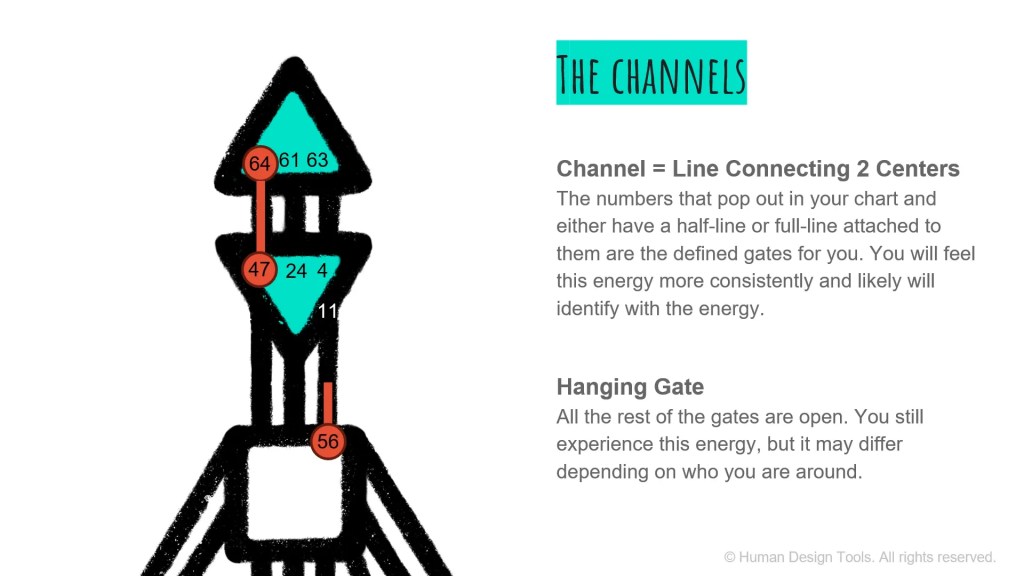
The lines in your chart denote channels, which connect two energy centers. A channel signifies a consistent energy flow between those centers:
Full Channels: These are represented by a complete line connecting two shapes. Both centers are defined, allowing for consistent energy flow.
Hanging Gates: These are partial connections where only one end of the channel is defined. You may feel the energy of this channel when around someone who connects to the other end.
Symbols and Their Meanings
The symbols on the chart represent the planets, each of which plays a role in how your energy is expressed. By understanding the relationship between your planets and gates, you can gain insights into your life’s purpose and how to fulfill it uniquely.
The Incarnation Cross, which is derived from the gates associated with your Sun and Earth planets, is particularly significant. It represents your life’s mission and the energies you are here to embody.
Decoding the Decimal Points
After the gate numbers, you’ll often see decimal points. These indicate the lines associated with each gate, providing a deeper layer of understanding regarding how that energy plays out in your life. The first number denotes one part of your profile, while the second number represents another aspect.
Conclusion and Resources
Understanding the Human Design chart can be a life-changing experience. It allows you to explore your unique energies and how they interact with the world around you. For a more in-depth understanding, consider exploring additional resources available at Human Design Tools.
Thank you for taking the time to delve into some of the components of the Human Design chart. I hope this guide has provided clarity and insight.


